The Instruments of Rembetiko: Bouzouki, Baglamas and the Smyrna Orchestra
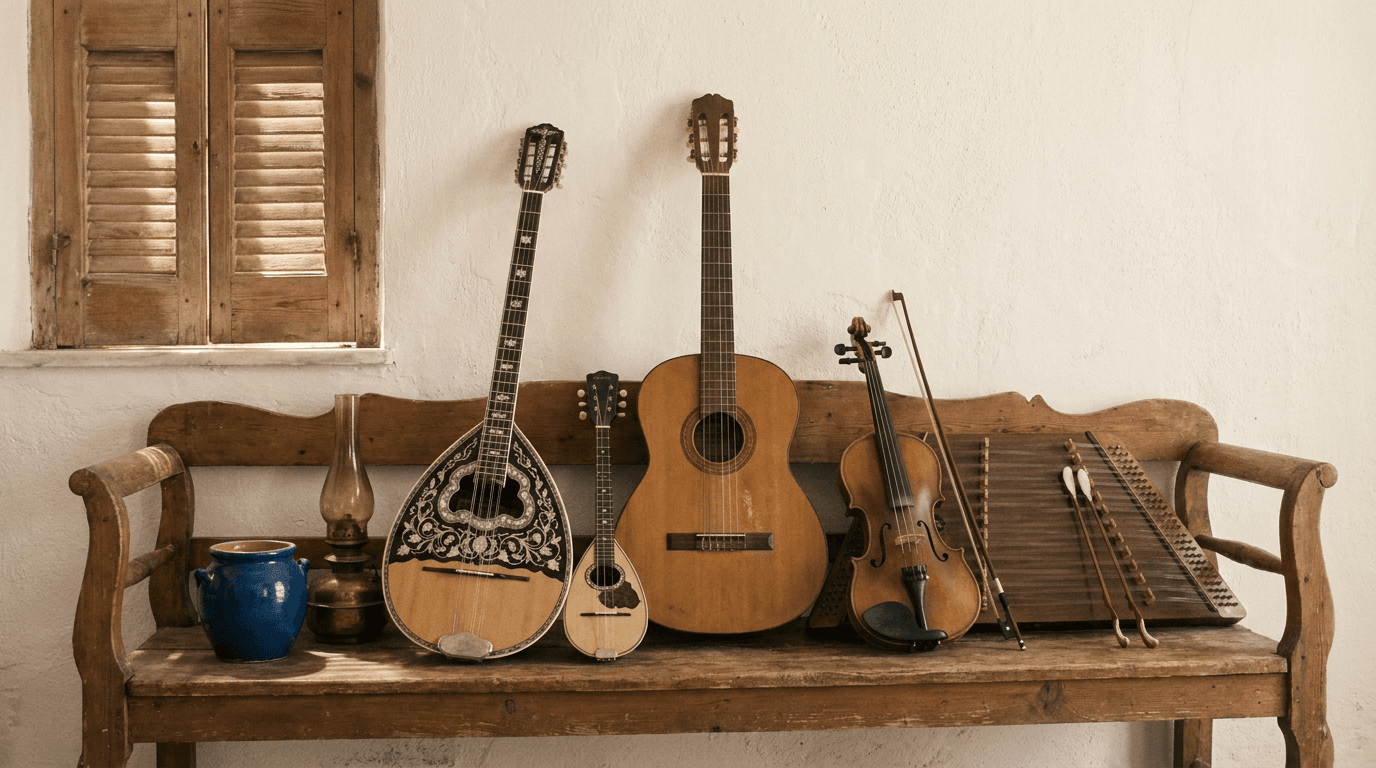
Rembetiko was really two musics that grew together, and you can hear the difference fastest in the instruments. The Smyrna school arrived with an Ottoman café orchestra: violin, santouri, oud, kanonaki. The Piraeus school answered with three plucked instruments a dockworker could afford: bouzouki, baglamas, guitar. This is a tour of both families, what each instrument does, and why the bouzouki won.
The bouzouki #
The long-necked lute at the center of it all belongs to the tambouras family, whose ancestors reach back through the Byzantine thamboura toward the ancient pandoura. The name is Turkish, from bozuk, meaning broken or modified. The classic rembetiko instrument is the trichordo: three double courses tuned D-A-D, with the lowest course strung in octaves, a tuning that, as musicologist Risto Pekka Pennanen notes in his study of chordal harmony in rebetika, favors D-based keys and sits naturally under the music's modal melodies. It "was the mainstay of most rebetiko music" (Wikipedia's organology article is solid on the details).
The four-course tetrachordo, tuned C-F-A-D like a guitar's top strings, is a 1950s development popularized by the virtuoso Manolis Chiotis, with the first four-course recordings appearing in 1956. It made flashy chordal playing easier and took over Greek popular music, which is why most bouzoukia sold today have four courses and rembetiko purists still hunt for three. Our whole site is built around the trichordo; you can see its neck laid out on the interactive fretboard.
The baglamas #
The baglamas is a bouzouki in miniature, tuned the same D-A-D one octave higher, and it may be the most story-rich instrument in Greek music. It was the instrument of prisons and hash dens precisely because of its size. As Roderick Conway Morris put it in his study of Greek café music, "the characteristic instruments of the hashish dens and prisons were the bouzouki and its smaller relations: the tzoura and the baglamas." A baglamas could be hidden under a coat when the police arrived, and prisoners built them from tin cans, gourds, even tortoise shells.
In the Piraeus ensembles its job is high, chiming rhythm chording that cuts through above the bouzouki. People sometimes call it percussion; it is not, but the description gets at how it functions. On this site, the baglamas gets a bonus: it tunes like a trichordo one octave up, so every fingering in our chord library works on both instruments unchanged.
The tzouras #
Between the two sits the tzouras, from the Turkish cura: bouzouki neck and head, notably smaller body, same D-A-D tuning in its six-string form. It trades the bouzouki's ring for something drier and more intimate, closer to its saz ancestry. Everything on this site that works for trichordo works for tzouras too.
The guitar #
The unsung workhorse. Old rembetiko bands had no rhythm section, so the guitar supplied both the rhythm and the bass at once: a bass note on the strong beat, chord on the answer, walking lines between phrases. Listen to any Vamvakaris side from the 1930s and the guitar is the floor everything stands on. If you write or play backing parts, our play-along composer models exactly this bass-and-chord style.
The Smyrna orchestra #
Before Piraeus took over, the café aman ensembles of Smyrna and Constantinople played with a very different palette (Conway Morris catalogues it beautifully):
Violin, the lead voice, ornamented and vocal in style
Santouri, the trapezoidal hammered dulcimer whose shimmer defines the Smyrneika sound
Outi (oud), the short-necked, unfretted lute with five string pairs
Kanonaki, the plucked board zither with movable levers for fine tuning
Politiki lyra, the small upright bowed lute of Constantinople
Percussion was light and portable: the defi frame drum with its jingles, zilia finger cymbals, the goblet-shaped toubeleki, and sometimes just wooden spoons played like castanets. Above it all floated the amanes, the improvised vocal lament that gave the cafés their name, the singer's equivalent of a bouzouki taximi.
After the population exchange of 1923 brought these musicians to Greece, the two styles shared stages and record labels for a decade. Gradually the bouzouki, in Wikipedia's phrasing, "began to emerge as the emblematic instrument of this music, gradually ousting the instruments which had been brought over from Asia Minor." By the mid-1930s the core of the music was the Piraeus trio: bouzouki, baglamas, guitar. Later recordings added accordion, piano, double bass and clarinet as rembetiko drifted toward laiko.
Hear the two worlds side by side. First the Smyrna school at its peak, Roza Eskenazi singing an amanes:
Then the Piraeus answer, Markos Vamvakaris in 1935:
Which one is for you? #
If you are starting out, the practical answer is a trichordo bouzouki or a tzouras, because they share tuning, repertoire and every learning tool on this site, from the tuner with its D-A-D preset to the fretboard explorer and lessons. A baglamas makes a wonderful second instrument, cheap, portable and identical in fingering. Our beginner's guide walks through buying, tuning and first steps.
Sources and further reading #
Roderick Conway Morris, Greek Cafe Music, Recorded Sound 83, 1981
Risto Pekka Pennanen, The Development of Chordal Harmony in Greek Rebetika and Laika Music, British Journal of Ethnomusicology 6, 1997
Gail Holst-Warhaft, Road to Rembetika, 1975, readable at the Internet Archive
Museum of Greek Folk Musical Instruments "Fivos Anoyanakis", Athens, on the tambouras family