The Dromoi: How Greek Music Organizes Melody
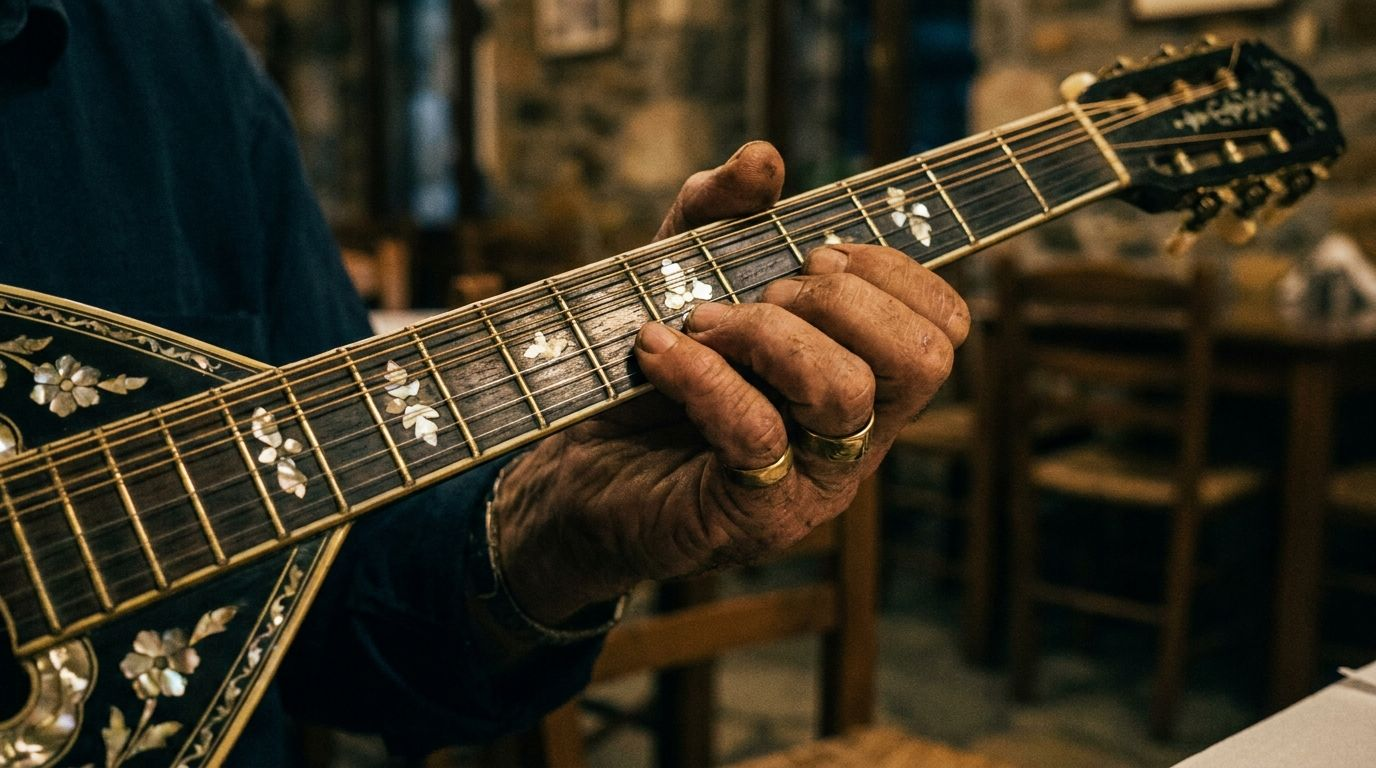
Ask a bouzouki player what scale a song uses and you will not hear "D harmonic minor". You will hear a road name. Dromos (δρόμος) means road or street in Greek, and the dromoi are the melodic roads that rembetiko and laiko music travel: rast, ousak, hitzaz, kiourdi, saba and the rest. Learn a handful of them and songs that seemed mysterious suddenly make sense under your fingers.
This article explains what the dromoi actually are, where the system came from, and how to start hearing the differences. Every dromos mentioned here can be explored, with sound, on our interactive fretboard.
A code between musicians, not a theory book #
The most honest definition comes from musicologist Nikos Ordoulidis, whose study "The Greek Popular Modes" (British Postgraduate Musicology 11, 2011) calls the dromoi "nothing more than a communication code used by Greek musicians". There is no official rulebook. The system is empirical, passed from player to player by ear, and it developed out of the modal traditions the musicians of the 1920s and 30s actually knew: above all the Ottoman version of the Arabic-Persian maqam system, with elements of Byzantine chant mixed in.
That inheritance shows up on the bandstand to this day. Ordoulidis describes how a bouzouki player calls the next song to the band with three words, something like "D minore zeibekiko". The word minore there does not name the dromos at all. It names the first chord of the song, and the actual road might be ousak, kiourdi or plain minor. The band figures it out from the melody. That is what an oral tradition sounds like from the inside.
Roads, not maqams #
Here is the point most beginners miss, and it matters. The dromoi descend from the maqams, but they are not the same thing, and the reason sits under your left hand: frets.
Ottoman music lives on mostly fretless or microtonally fretted instruments and uses intervals smaller than a semitone. The bouzouki, like a guitar, has fixed frets in equal semitones. When the refugee musicians of the Asia Minor Catastrophe brought their maqam-based music to Piraeus, and the locals took it up on the bouzouki, every microtone had to land on the nearest fret. As Ordoulidis puts it, the Greek ousak simply cannot be the Ottoman ussak, because the microtones are gone. The dromoi are the maqams translated into the twelve-tone grid, and in translation they became something new.
The names got scrambled along the way too. Musicians historically attached maqam names to roads that do not match the original maqams; Risto Pekka Pennanen traces the confusion to "deficient knowledge of the Ottoman music culture" among the early players. The practice-based bouzouki books of the last century disagree with each other about names and structures for the same reason. So if you have seen two conflicting versions of the same dromos online, you are not going crazy. The tradition genuinely contains both. When we built our dromoi reference, we checked the interval sets against the academic literature rather than copying any single player's book.
What makes a dromos more than a scale #
Greek players usually teach the dromoi as eight-note scales, but Ordoulidis points out that the parent systems think in smaller building blocks: tetrachords and pentachords, four and five note cells stacked together. That is also the best way to hear them. A dromos is really a lower cell plus an upper cell, and the character lives in which cells you stack.
A dromos also carries habits that no scale diagram shows:
Directional behavior. Some roads change on the way down. In ousak, the second degree is famously unstable, sounding flat or natural depending on which way the melody is moving. Our fretboard marks ascending and descending forms separately where they differ, for exactly this reason.
Gravitations. Borrowed from Byzantine theory, the idea of elxis: certain notes pull their neighbors toward themselves. In ousak, the sixth degree tends to be dragged upward toward the seventh in rising phrases.
Idiomatic moves. Players of ousak and hitzaz love an ascending major run below the home note before rising into the mode proper. It sounds like a modulation. It is not. It is just what those roads do.
Five roads to start with #
You can explore all of these with audio on the fretboard, and drill them in the dromoi quizzes.
Rast is the sunny one, close to a major scale but with a seventh that tends to soften on the way down. A natural first road.
Ousak is the aching one, a minor-flavored road with that unstable second degree. Much of the deepest rembetiko lives here.
Hitzaz is the one everyone recognizes, with the wide, dramatic step near the bottom that instantly sounds like the eastern Mediterranean.
Kiourdi behaves differently going up and coming down, which makes it a lesson in directional playing all by itself.
Saba is the strange and beautiful one, with a low fourth degree that gives it a permanently unresolved color.
Those five are a starting kit, not the whole map. We are publishing a full article on every major road over the coming months, each with its history, its positions and songs to hear it in: rast, hitzaz, ousak, kurdi, houseini, sabah, niavent, hitzazkiar, pireaiotikos, houzam, segah, karczigar and souzinak. Each name becomes a direct link as its article goes live.
The taximi: where the dromos becomes music #
The purest expression of a dromos is the taximi, the free, unmetered improvisation a player spins at the start of a song while the other instruments hold a drone. Its job, in the tradition, is to establish the tonality and the road, and to show what the player has to say. Every great rembetiko record with a long, wandering bouzouki introduction is a taximi doing its work. When you have a couple of roads under your fingers, try it: no rhythm, one dromos, and honesty. It is the most personal thing this music asks of you.
The name felt right for other reasons too, but that is another story.
Go play them #
Reading about roads gets you nowhere by definition. Open the fretboard explorer, pick rast, and play it up and down until it stops feeling like a scale and starts feeling like a place. Then try the same melody in hitzaz and hear what changes. When chords enter the picture, the chord library shows which harmonies each road invites.
Sources and further reading #
Nikos Ordoulidis, "The Greek Popular Modes", British Postgraduate Musicology 11, 2011
Risto Pekka Pennanen, "The Nationalization of Ottoman Popular Music in Greece", Ethnomusicology 48/1, 2004
Risto Pekka Pennanen, quoted on terminology in Ordoulidis 2011
Gail Holst-Warhaft, Road to Rembetika, Denise Harvey, 4th ed., on the world the dromoi lived in