Getting Started on the Bouzouki: An Honest Beginner's Guide
This guide is written learner to learner. RebetiChord itself exists because one of us wanted to practice scales and could not find the right tool, so take everything here in that spirit: practical, honest about the hard parts, and free of the "master the bouzouki in 30 days" nonsense. Learning this instrument is not fast. It is, however, one of the best things you can do with your hands.
Which bouzouki? Trichordo and tetrachordo #
The first fork in the road comes before you own an instrument. The trichordo has three double courses of strings and is the bouzouki of classic rembetiko. The tetrachordo has four courses, was popularized by Manolis Chiotis in the 1950s, and dominates the modern market so completely that big European retailers often stock nothing else (Wikipedia's overview is accurate here).
Which to start on is a genuine debate. Some teachers point beginners at the four-course because guitar chord shapes transfer to it. Others, like the rebetiko-focused teacher behind Tapadum's buying guide, say that if the old music is what you love, start on the instrument it was made on. This site is built around the trichordo, and that is our honest bias: the open D-A-D tuning sits under the modal melodies of rembetiko in a way the guitar-like tuning does not.
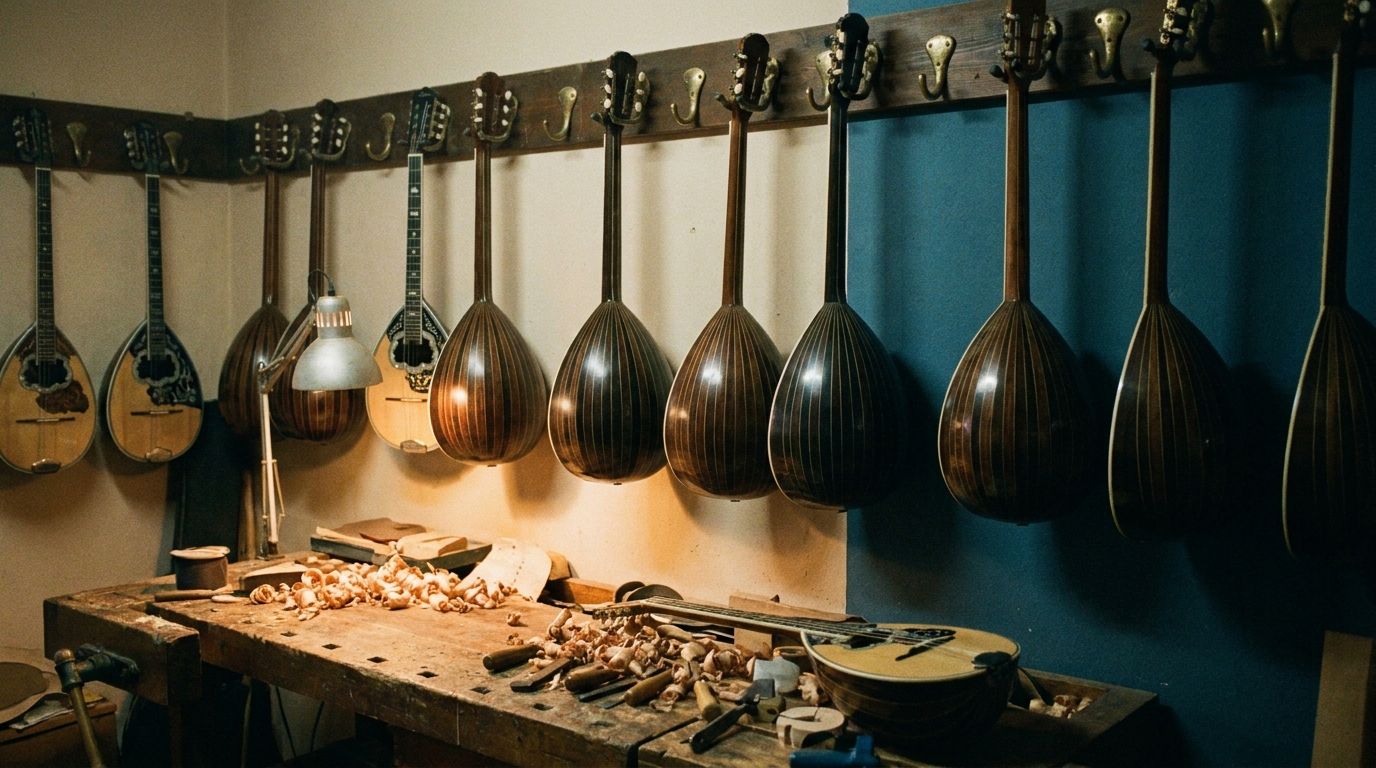
On price, a new entry-level trichordo runs roughly 500 to 650 euros from Greek retailers, while handmade instruments from workshops like Tsakirian in Athens, a family firm since 1924, sit mostly between 1,600 and 1,800 euros. A decent starter instrument is fine. Nobody ever quit bouzouki because their first instrument lacked mother-of-pearl.
Tuning: D-A-D #
The trichordo tunes D-A-D. The middle and top courses are unison pairs, and the low D course is the interesting one: it pairs a thick wound string with a thin string an octave higher, arranged so your downstroke hits the low note first. That octave shimmer is a big part of the sound. If you are stringing from scratch, the standard set (D'Addario EJ97-6 or the Greek-made equivalents) uses .011s on top, .014s in the middle, and a .022 wound with an .011 for the low course.
Tune with your ears eventually, but start with your eyes: the free browser tuner on this site has a trichordo D-A-D preset and works from your microphone. No app, no account.
Holding it, and the pick #
The round bowl back is genuinely awkward at first. Everyone finds this. Rest the bowl on your right thigh, snug against your stomach, and let your left thumb sit behind the neck with your fingers arched over the strings. Teachers give whole lessons on just this (Michael Teo has a good written one), so if the instrument keeps slipping, the problem is normal and fixable.
The pick, the penna, was once cut from feather or horn. Today it is plastic, and most players settle on a fairly stiff pick somewhere around 0.7 to 1.1 mm with a pointed tip. That range comes from player consensus rather than any official rulebook, so experiment. The pick matters more than beginners expect, because of what comes next.
Tremolo, the long game #
The singing, sustained sound of the bouzouki is tremolo: rapid, even down-up strokes on one note. It is the signature technique of the instrument and it is not quick to earn. The standard method books, like the Hal Leonard Greek Bouzouki Method, sequence it sensibly: single notes with downstrokes first, then alternate picking, then hammer-ons and slides, and only then tremolo. Rebetiko specialist Carmelo Siciliano teaches the same priority: right hand fundamentals before everything, because tone lives in the pick hand.
Give tremolo five patient minutes a day rather than one frustrated hour a week. Slow, even, relaxed. Speed is a byproduct.
Your first scales are dromoi #
Bouzouki melody is organized by the dromoi, the "roads" of Greek popular music. Instead of practicing major scales out of duty, you get to practice rast, ousak and hitzaz, which sound like the actual music from day one. The interactive fretboard on this site lights up every dromos on a trichordo neck with audio, and the quizzes will drill the notes into you. Old-school players learned by ear from records, which is how Markos Vamvakaris did it. You have better tools and the same records.
Your first rhythm #
Rebetiko teachers generally start students on a practical set of dances: hasapiko, zeibekiko, tsifteteli, syrtos. Our suggestion is to begin with the hasapiko, a straightforward duple rhythm, before attempting the famous nine-beat zeibekiko. That ordering is common sense rather than doctrine, but counting to four convincingly before counting to nine has a lot going for it. We have a whole article on rembetiko rhythms and how to count them if you want to go deeper.
A practice routine that survives real life #
Short and daily beats long and rare. Fifteen focused minutes, most days, will outrun a three-hour Sunday blitz, and every credible teacher says some version of this. A workable beginner session:
Two minutes of tuning and open-string picking to settle in
Five minutes of one dromos, slowly, with a metronome
Five minutes of rhythm work or a song fragment
Three minutes of tremolo, relaxed, no clock-watching
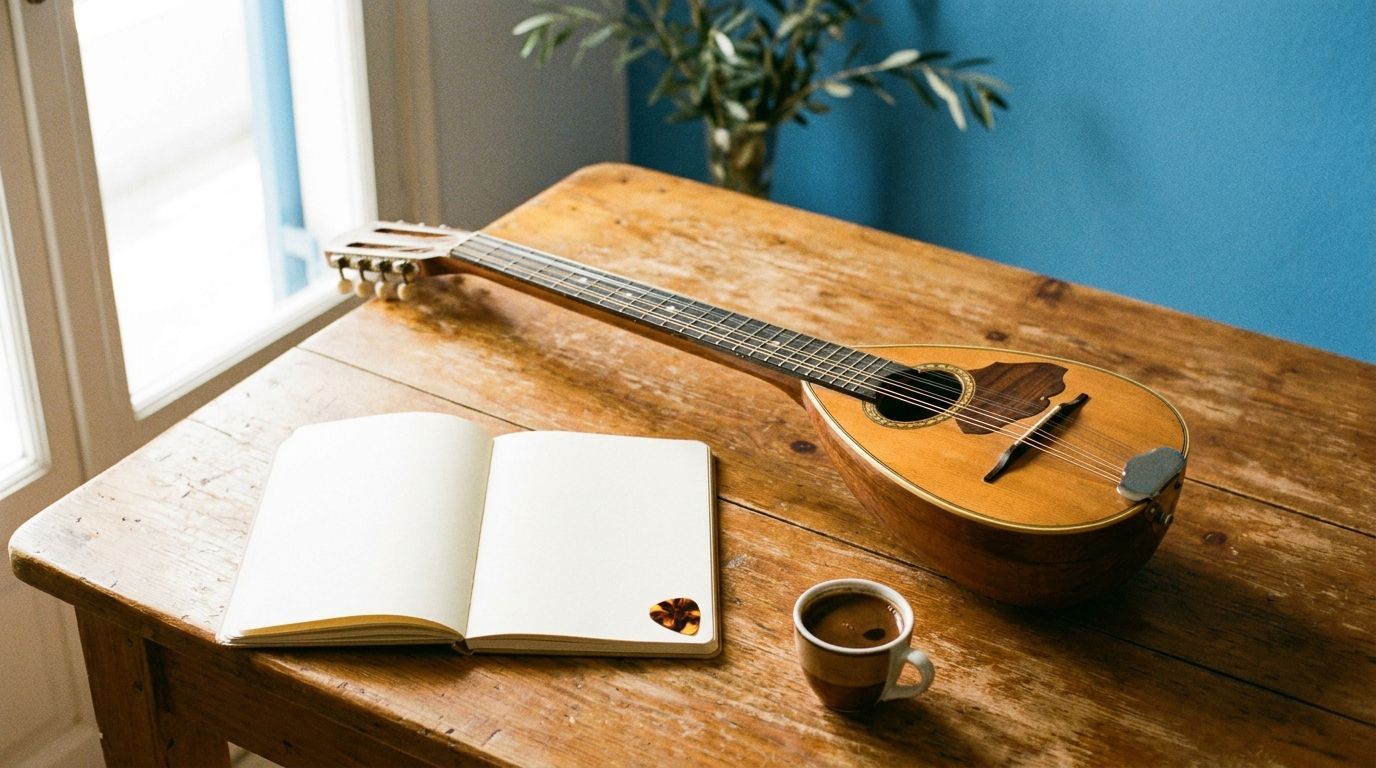
Log what you practice. Even a notebook line per day changes how fast you improve, because you stop re-practicing what you already know.
Listen more than you play #
The fastest way to sound Greek is to fill your ears with the originals. Start with Markos Vamvakaris, Vasilis Tsitsanis, Yiannis Papaioannou and Manolis Chiotis. The compilation "Bouzouki Pioneer: Markos Vamvakaris 1932-1940" is a fine first purchase, and our history of rembetiko tells you who all these people were and why they matter.
When you are ready to play along with real progressions, the community tabs here are free, shared by players like you. And if you get stuck, live tutors on the site teach one to one.
Take the long road. It is the point of the instrument.
Sources #
Wikipedia, "Bouzouki" on trichordo construction and tuning