A Short History of Rembetiko: From Smyrna's Cafés to UNESCO
Rembetiko is often called the Greek blues, and the comparison earns its keep. Both are urban musics born at the bottom of society. Both were despised before they were loved. And both carry more truth about their era than most official histories do. In 2017 UNESCO added rembetiko to its list of the Intangible Cultural Heritage of Humanity, describing it as a music that "initially spread among the urban lower and working-class populations" of Greece in the early twentieth century. It took about a hundred years to travel from the hash den to the honors list. This is the short version of how.
Before Greece: the café aman world #
The story starts outside the borders of the modern Greek state, in the port cities of the late Ottoman world. In Smyrna and Constantinople, music cafés known as café aman hosted singers who improvised long, melismatic laments punctuated by the cry "aman" (roughly, "mercy"). The genre took its name from that cry: the amanes. The singers were Greek, Jewish, Armenian and Roma, and the style they shared drew on Ottoman classical music, Byzantine chant and regional folk song all at once.
Recording actually caught up with this music in America before it did in Greece. Labels like Columbia and Victor began recording Greek repertoire for the immigrant market around 1916, and singers such as Marika Papagika cut hundreds of sides in New York through the 1920s (Bucuvalas and Frangos, "Overview of Greek Music in America"). One warning if you go digging through old discographies yourself: scholars consider the published dates of many early rebetika records unreliable, a point made sharply by Ole L. Smith in his 1991 paper "The chronology of Rebetiko".
1922: the catastrophe that moved a music #
Everything changed with the Asia Minor Catastrophe. After the destruction of Smyrna in 1922 and the compulsory population exchange agreed at Lausanne in 1923, roughly 1.2 million Orthodox Christian refugees arrived in Greece, swelling the country's population by more than a fifth within months (World Bank study, 2022). Great numbers of them settled in Piraeus, Athens and Thessaloniki, and among them were professional musicians of the Smyrna school, some of whom went on to run the artistic side of the Greek record industry.
What happened next is the heart of the whole story. The refined, violin-and-santouri café music of the refugees met the rougher world of the Piraeus docks, and over the course of the 1920s and 30s the two idioms merged. Musicologist Risto Pekka Pennanen has traced this process in detail in his work on the nationalization of Ottoman popular music in Greece.
Piraeus: tekedes, manges and the bouzouki #
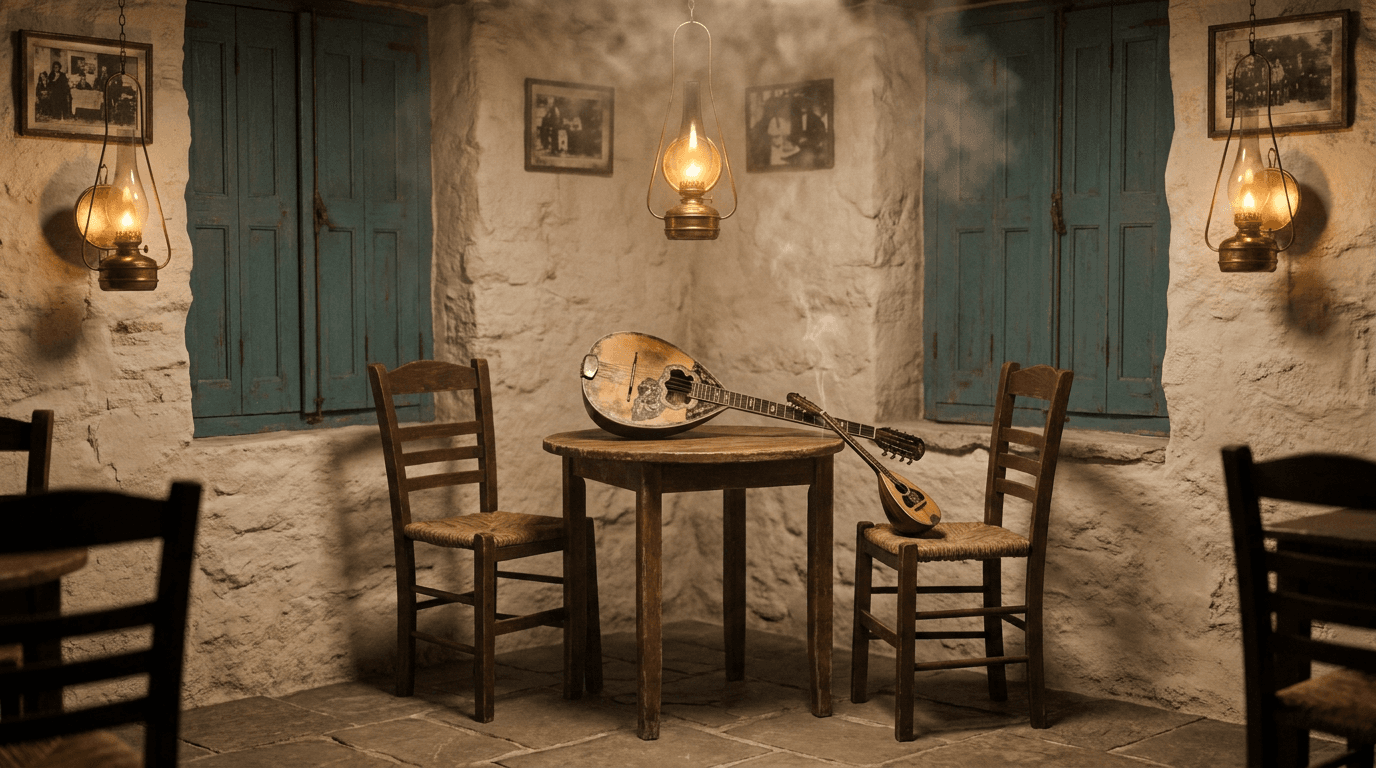
The Piraeus side of the music lived in the tekedes, the hashish dens, among the manges: streetwise men with their own dress code, their own slang and their own dances. The songs talked about what life there actually contained. Hashish, prison, poverty, love and death, mostly. Gail Holst-Warhaft's classic study Road to Rembetika, first published in 1975, is still the best introduction in English to this world, and its subtitle says it plainly: songs of love, sorrow and hashish.
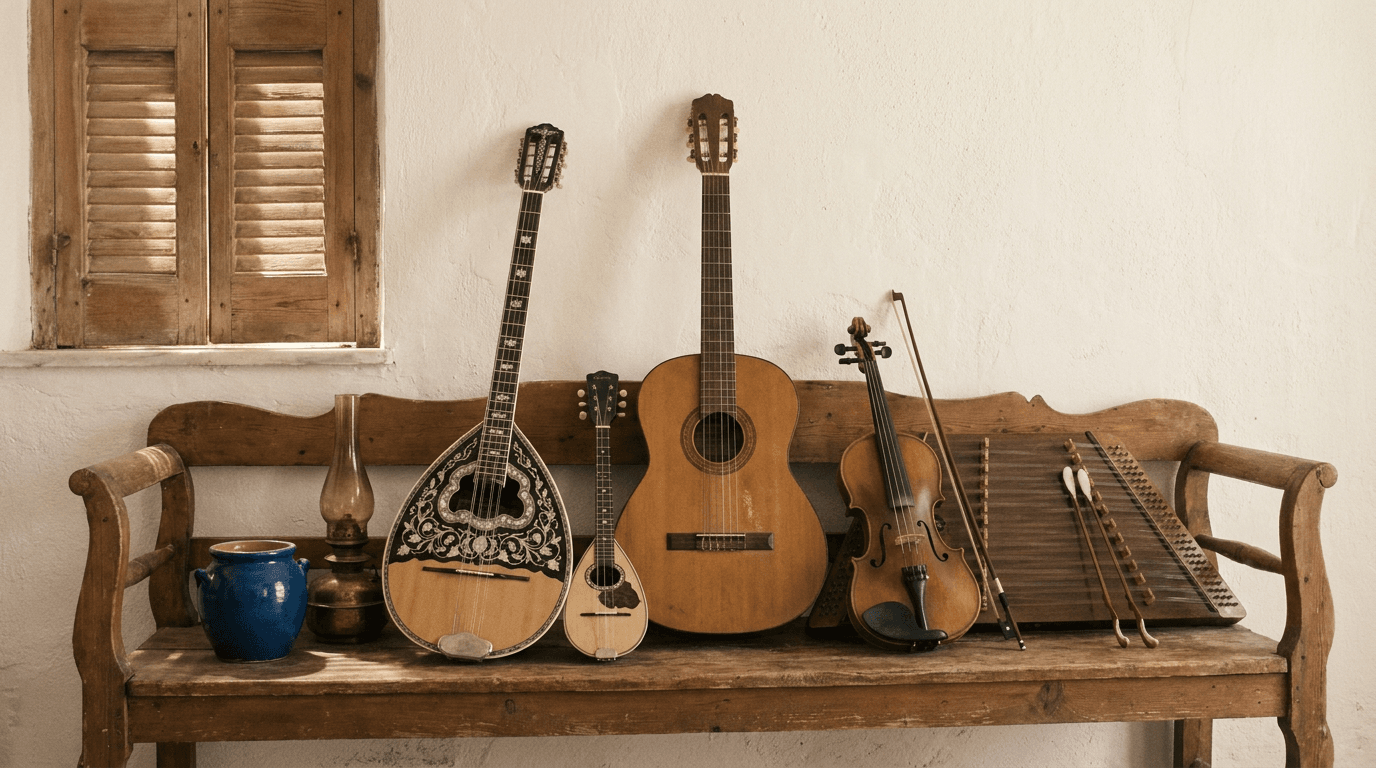
The instrument at the center of it was the three-course bouzouki, backed by its tiny cousin the baglamas. Oddly enough, the record that made the bouzouki famous was cut in New York: Ioannis Halikias's instrumental "Minore tou Teke", recorded for Columbia in January 1932, was a sensation back in Greece. Here is an archival transfer of that record:
Two years later, in 1934, Markos Vamvakaris formed the group history remembers as the Famous Quartet of Piraeus, with Giorgos Batis, Anestis Delias and Stratos Pagioumtzis. It was the first working ensemble built around bouzouki and baglamas, and Vamvakaris, "the patriarch of rembetiko", became its defining voice. His "Frangosyriani" of 1935 may be the most loved rembetiko song ever recorded:
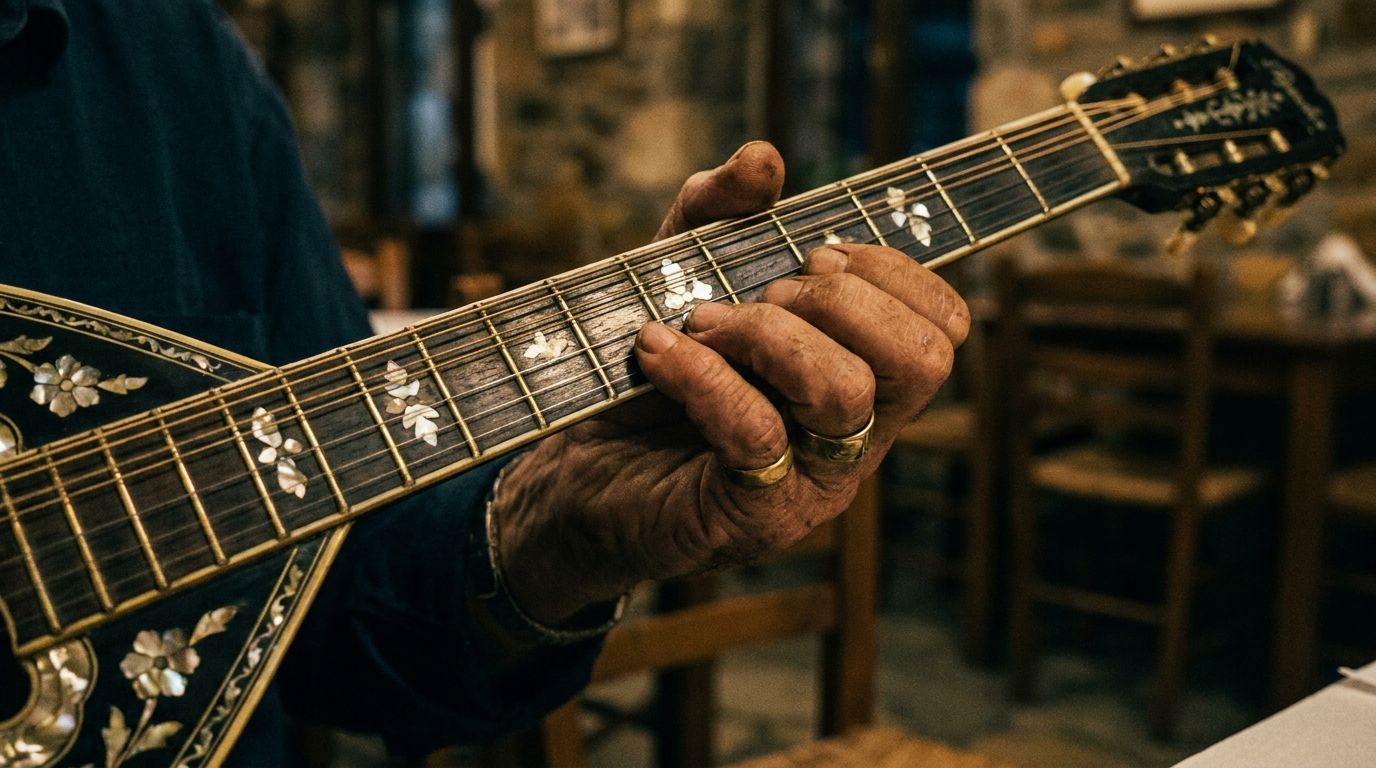
If you want to see how the melodies of this era work under the fingers, the scales and dromoi explorer on this site maps them fret by fret.
1936: the censor arrives #
In 1936 the Metaxas dictatorship took power, and from 1937 records had to pass a censorship board before release. Songs about hashish and the underworld were banned, existing discs were withdrawn, tekedes were raided and shut, and the amanes itself was prohibited as an "anachronistic" oriental relic that did not fit the regime's Europeanized image of Greece. Pennanen's paper on Greek music policy under Metaxas is the definitive account. Songwriters adapted by cleaning up their themes, a shift that pointed straight at the music's next chapter.
The postwar turn #
That chapter belongs to Vasilis Tsitsanis. His "Synnefiasmeni Kyriaki" (Cloudy Sunday), composed during the German occupation of Thessaloniki, was first recorded in 1948 by Prodromos Tsaousakis and Sotiria Bellou, and Greeks have treated it as a kind of unofficial national anthem ever since (University of Ioannina Tsitsanis archive). The first recording is here:
Around Tsitsanis gathered the great postwar voices, Sotiria Bellou from 1945 and Marika Ninou from 1949, the pair of singers whose recordings still define the repertoire for most listeners.
Decline, revival, recognition #
In the mid-1950s Manolis Chiotis popularized a four-course bouzouki tuned like the top of a guitar, and the flashy nightclub style it enabled carried Greek popular music away from rembetiko and into laiko. The old music seemed finished. Then it was rescued twice. First from above, when composers like Manos Hadjidakis and Mikis Theodorakis built art music on its foundations around 1960 and made the bouzouki respectable. Then from below, when students rediscovered the original 78s in the 1970s. After the junta fell in 1974, reissue series like EMI's six-volume "Rebetiki Istoria" and a wave of young revival bands turned rembetiko into a living tradition again (Greek Music Information Centre). Costas Ferris's film "Rembetiko" won the Silver Bear at Berlin in 1984, and in December 2017 UNESCO made the recognition official.
The music never really needed the certificate. A zeibekiko still clears a floor in any Greek taverna, and the songs of a Syros dockworker from the 1930s are still being learned, note by note, by people all over the world. Some of them on this site.
Learn the music itself #
Reading about rembetiko is one thing. Playing it is better. The free lessons here cover the tradition from the ground up, the chord library has every fingering you will meet, and when your bouzouki inevitably drifts, the tuner is free and lives in your browser.
Sources and further reading #
UNESCO, Rebetiko, Representative List of the Intangible Cultural Heritage of Humanity, 2017
Gail Holst-Warhaft, Road to Rembetika, Denise Harvey, 4th ed.
Elias Petropoulos, Songs of the Greek Underworld: The Rebetika Tradition, Saqi Books, 2000
Risto Pekka Pennanen, The Nationalization of Ottoman Popular Music in Greece, Ethnomusicology 48/1, 2004
Risto Pekka Pennanen, Greek Music Policy under the Dictatorship of General Ioannis Metaxas, Finnish Institute at Athens, 2003
Ole L. Smith, The chronology of Rebetiko, Byzantine and Modern Greek Studies 15, 1991
Tina Bucuvalas and Stavros K. Frangos, Overview of Greek Music in America