Counting Rembetiko: Zeibekiko, Hasapiko and the Rhythms of Greek Music
The first time you try to clap along to a zeibekiko, you will lose your place. Everyone does. Rembetiko runs on rhythms that western pop never uses, including a nine-beat cycle that feels like it should stumble and never does. The good news is that every one of these rhythms has a simple internal logic, and once you can count them, you can hear them instantly for the rest of your life. This article covers the main dance rhythms of rembetiko, how each is counted, and how to practice them.
A note before the numbers: whether a zeibekiko is written as 9/4 or 9/8 is purely a notation choice. As dance researcher Fred Bolder puts it in his Guide to Zeibekiko Dancing, it makes no difference which you write; the bottom number does not set the tempo. What matters is the grouping.
Zeibekiko: the nine #
The king of rembetiko rhythms, named after the Zeybeks, the irregular militias of Ottoman Anatolia, and carried to the mainland with the refugees of 1922. Nine beats, classically grouped:
2 + 2 + 2 + 3, counted ONE-two, THREE-four, FIVE-six, SEVEN-eight-nine.
Dancers step on 1, 3, 5 and 7, and that final three-beat group is the signature: the moment where the cycle seems to hang in the air before starting again. Bolder's practical advice for finding beat one is to listen for the measure ending "with three slow counts"; drummers often place a fill right across them. The modern or "new" zeibekiko keeps nine beats but phrases them as two identical halves of four plus a ninth beat on its own, which Greek teachers count as diplo-diplo-mono.
Hear it under a real song. This is Vamvakaris's "Frangosyriani" from 1935, a canonical zeibekiko:
And here is the bare drum pattern, useful for practice:
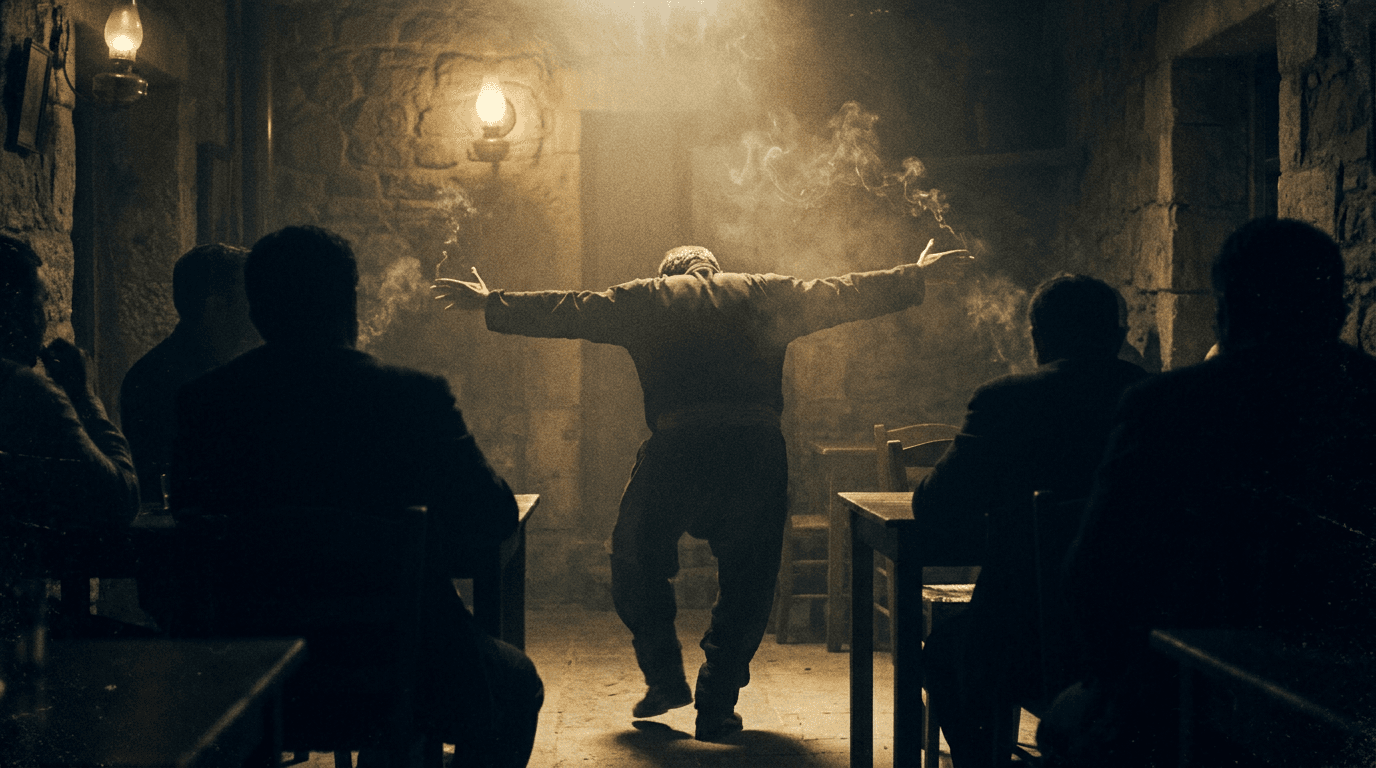
The dance deserves its own paragraph, because it explains the music. Zeibekiko is a solo improvised dance with no set steps, traditionally danced by one man alone inside a circle of seated friends, arms out like a hawk. Nobody joins in. Gail Holst-Warhaft called it "the passionate introspective zebekiko" in Road to Rembetika, and introspective is the word: it is not a performance for the room, it is a conversation with the song.
One practical warning from Bolder worth passing on: not every zeibekiko keeps nine beats in every bar. Some songs drop counts in certain measures, so trust your ears over your arithmetic when a song seems to cheat. It probably is.
Hasapiko: the butcher's dance #
The other pillar of the repertoire, and the friendly one. The slow hasapiko (hasapiko varry) moves in an even 4/4, danced by two or three people in a line with arms over shoulders, executing synchronized steps. Its history is wonderful: it descends from a medieval sword mime of the Greek butchers' guild of Constantinople, the makellarikos horos (the history is well documented). If you have ever seen the choreographed sirtaki of Zorba fame, that is a stage arrangement built on hasapiko bones.
The fast version, the hasaposerviko, runs in 2/4 and shows its Balkan borrowings in the name. Together, as the rebetika literature notes, the nine of the zeibekiko and the duple hasapiko are the two most common rhythms in the whole genre.
For counting practice, Tsitsanis's "Synnefiasmeni Kyriaki" is commonly danced as a slow hasapiko:
If you are learning bouzouki, start here before the nine. Counting to four convincingly is the foundation everything else stands on. Our play-along tool has per-rhythm backing patterns for exactly this kind of practice.
Tsifteteli: the four that sways #
From the Turkish çiftetelli, "double strings", originally naming a violin technique. In Greek practice it is a 4/4 with a swaying stress pattern, the belly-dance rhythm of the eastern Mediterranean, and it came into rembetiko through Smyrna. The most famous tsifteteli ever recorded is one you already know: "Misirlou", first recorded around 1930 by Michalis Patrinos in exactly this style, decades before surf guitar found it:
Karsilamas: nine, face to face #
The zeibekiko's sociable cousin uses the same nine beats in the same 2+2+2+3 grouping, but faster and as a couple dance, performed face to face. The name comes from the Turkish karşılama, a greeting or encounter. Where the zeibekiko is solitary and inward, the karsilamas is flirtatious and outward, and hearing the same nine-count serve both moods is a small education in what rhythm actually does in music.
Related nine-beat forms fill out the family: the aptaliko, treated in the sources as a predecessor and relative of the zeibekiko, and slower and faster variants that the old players moved between freely.
Kalamatianos: the seven next door #
Strictly speaking the kalamatianos is folk music rather than rembetiko, but its 7/8, grouped 3+2+2 and felt as slow-quick-quick, appears all over the wider Greek repertoire you will meet as a player, so learn the count. Here is the great Domna Samiou with a syrtos kalamatianos:
How to actually learn these #
Count out loud with the groupings, not just numbers: ONE-two THREE-four FIVE-six SEVEN-eight-nine. Your mouth teaches your hands.
Tap long-short patterns. For the nine, tap four even beats then one longer one. For the seven, long-short-short.
Listen for the drummer's fill at the end of the zeibekiko cycle; it is a signpost planted on purpose.
Practice with backing. The play-along composer on this site has rhythm patterns for these dances, and the community tabs mark each song's rhythm so you can pick practice material by count.
Watch dancers. The steps encode the count. A zeibekiko dancer's slow turns during the final three beats will teach you more than any diagram.
Since this guide was written, we have built a free tool for exactly this problem: the Rhythm Trainer draws each rhythm as its true grouped shape, plays the toubeleki figures, and lets you tap along until the meter moves from your head to your hands. The thinking behind it — and the theory of these additive meters — is in Feeling the Nine.
Sources and further reading #
Fred Bolder, Guide to Zeibekiko Dancing, on counting, groupings and dance practice
Gail Holst-Warhaft, Road to Rembetika, 1975
Wikipedia entries on Zeibekiko, Hasapiko, Tsifteteli, Karsilamas and Kalamatianos
Folkdance Footnotes for the dance-side history of each rhythm