Hitzaz: The Road Everyone Recognizes
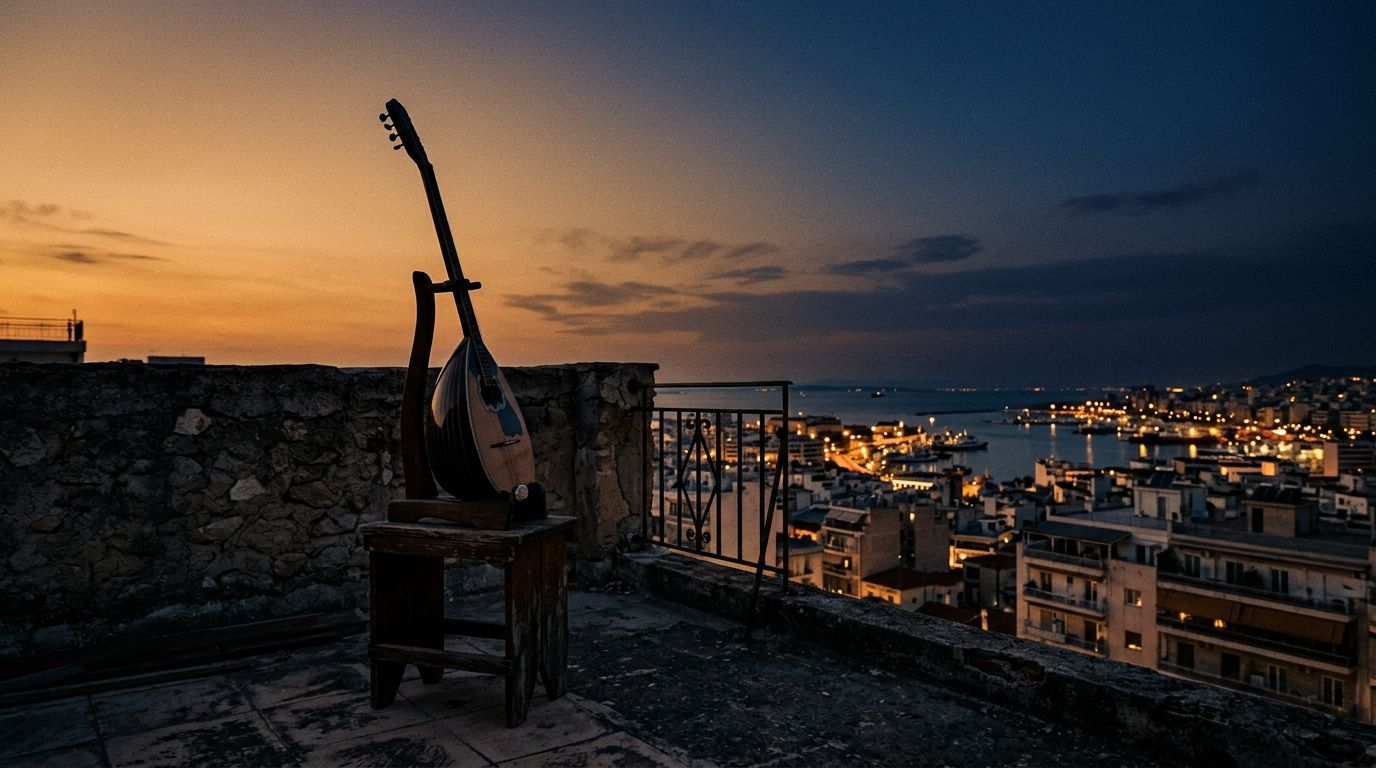
Second in our series on the dromoi, after rast, the daylight road. Hitzaz is the opposite hour of the day. Play four notes of it anywhere on earth and listeners will tell you it sounds "eastern," "ancient," or simply "Greek," even if they cannot name a single Greek song. That instant recognizability comes from one interval, and this article is mostly about that interval: where it sits, why it aches, and how to use it without turning it into a postcard.
Open hitzaz on the fretboard and listen along.
The augmented second #
Start on D. Lower the second degree, raise the third. The gap that opens between them — E-flat up to F-sharp, three half-steps wide where a scale normally walks in ones and twos — is the augmented second, and it is the entire signature of the road. Melodies crossing that gap cannot glide; they leap, and the leap is what your ear flags as longing.
The name travels the same route as most of the dromoi: from the maqam tradition of the Ottoman world (the ancestor is maqam Hicaz, named for the Hejaz region of Arabia), absorbed into Greek practice by the café musicians and refugees who built rembetiko, and squared onto the bouzouki's twelve equal frets. As musicologist Nikos Ordoulidis documents in "The Greek Popular Modes" (British Postgraduate Musicology 11, 2011), the Greek road is not the Ottoman maqam — the microtones that colored the original are gone — but the drama of the augmented second survived the translation intact, and the Greeks built half their saddest songbook on it.
One practice habit worth stealing from the tradition, which Ordoulidis describes: players of hitzaz love an ascending major run below the home note before rising into the road proper. It sounds like a brief visit to another key. It is not a modulation; it is an idiom, the road stretching before it sings.
Where you have already heard it #
Everywhere. The dramatic opening taximia of countless rembetika. A great deal of the zeibekiko repertoire — the solitary nine-beat dance and hitzaz's ache were made for each other, and our rhythm guide covers that pairing from the counting side. Beyond Greece, the same interval structure runs through Klezmer's Freygish mode, Andalusian flamenco's Phrygian dominant, and film scores reaching for "the East" — which is precisely why restraint is part of playing hitzaz well. The old players didn't lean on the interval; they let it arrive.
Chords that live on this road #
The harmony under hitzaz has a famous surprise in it: the chord on the home note is major, despite the road's dark color. On a D hitzaz, D major is home base, with E-flat major sitting a half-step above it — that pair of neighboring major chords, rocking a semitone apart, is one of the most recognizable sounds in Greek music. Both are in the chord library with fingerings and audio, and the play-along composer will loop the pair under you while you run the road on top.
Practicing it #
Isolate the leap. Play only ♭2 to 3, E-flat to F-sharp, slowly, with tremolo on each end. Get comfortable with how wide it feels under the fingers.
Approach from below. Practice the idiomatic major run up to the home note, then the road above it. Entry and ascent are where hitzaz phrases live.
Rock the two majors. D to E-flat and back on the chords, then improvise over them. Eight notes, no rhythm — a first hitzaz taximi.
Contrast-train. Alternate a phrase of rast with the same phrase bent into hitzaz. Daylight, dusk, daylight, dusk. This is the fastest way to make the dromoi real to your ear.
Drill the notes in the quizzes until the shape needs no thought.
Next in the series: ousak, the gentle minor with the famously unstable second — the road where the deepest rembetiko lives.
Sources and further reading #
Nikos Ordoulidis, "The Greek Popular Modes", British Postgraduate Musicology 11, 2011
Risto Pekka Pennanen, "The Nationalization of Ottoman Popular Music in Greece", Ethnomusicology 48/1, 2004
Our series introduction: The Dromoi: How Greek Music Organizes Melody